
At Your School

Clark Planetarium's AstroVan is a free program that visits every school district every year focusing on schools with 6th grade students. Larger districts with multiple schools will be visited on a rotating basis. Programs last approximately 45 minutes and are typically presented to individual classes of students generally covereing the ewntire grade level during our visit.
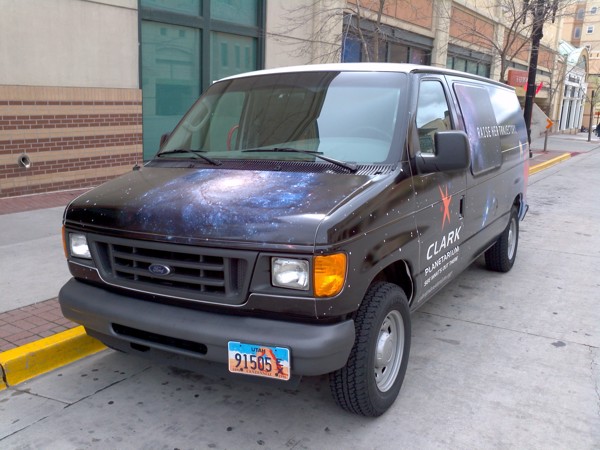
A truck parked on the side of a street.

AstroVan Presentations

This presentation explores the size, scale, distance and properties of objects in our solar system. Students will model the distances between the planets using physical models with ropes and planet cards. They will also use real data to identify the relative sizes of the planets, and classify the planets as inner, outer, rocky, gas giants, dwarf planets, etc.​

This presentation explores the interaction of the Sun, Moon and Earth system. Students will learn to identify the phases of the Moon and how they appear both from space and from Earth using golf balls painted with fluorescent paint and ultraviolet lights. Students will analyze data from lunar and solar eclipses to determine why they do not occur every month.​

This presentation explores how the forces of gravity and inertia must be balanced to achieve a stable orbit. Using a large floor mat, students model the planets to see how distance and velocity are related. With Universe Sandbox software, we demonstrate how changing planetary velocities, gravity, and distances effect their orbits, and how inertia is a property of matter.​

This presentation explores the rotation of the Earth and its orbit around the Sun. Using Starry Night software, we lead students to investigate the apparent motion of the Sun across our sky, why we experience day and night, and the reason we see different stars during each season. Students will become the Earth during a series of kinesthetic activities that model rotation and orbit.​

To learn more about the nature of our Sun and the changing cycles of day and night during the year, this lesson combines viewing the sun through a solar telescope with activities using a sundial. Students will complete four activities outside, each one requiring gathering and analyzing data. These activities include looking for features on the sun such as sunspots, measuring the time of day and the length of a day using a sundial, and using the height of a student compared with their shadow to find the time of year.